
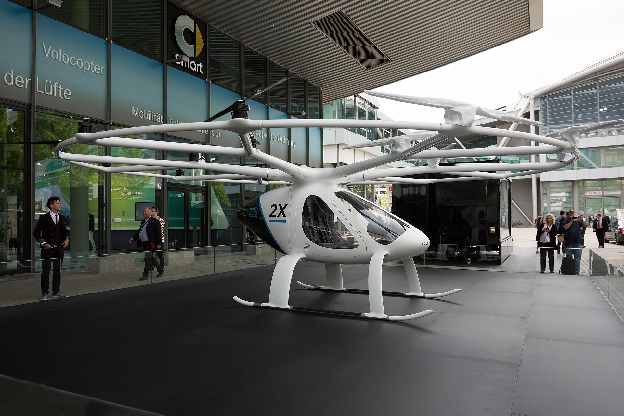
Photo by Matti Blume
You’re in the Wrong Forest: What Air Taxis Teach Us About Innovation Failures#
There’s an old story about a logging company owner. He goes out to check on his crew and finds them deep in the woods, working hard, axes swinging, trees coming down at an impressive clip. When they spot him, they shout down from the slope, “We’re making great progress!”
The owner looks around, sighs and rubs his forehead, then shouts back: “You’re in the wrong forest!”
Great progress. Wrong trees.
In innovation, progress and the right progress are not the same thing. You can swing the axe as hard as you want, fell tree after tree, and feel terrific about your momentum—right up until you realize you’ve been cutting in the wrong forest the entire time.
That’s exactly what happened with the spectacular, billion-dollar collapse of the air taxi industry.
The Lemmings Go Off the Cliff#
For the better part of a decade, eVTOLs (electric vertical takeoff and landing aircraft)—a.k.a., air taxis that look a bit like large drones—were one of the hottest bets in transportation. In 2019, Morgan Stanley projected that the autonomous aircraft market could reach $1.5 trillion by 2040. The pitch was irresistible: skip the traffic, hop into a quiet electric aircraft, and zip across the city or out to the airport. It was going to revolutionize how we move. And the money came pouring in.
Volocopter, one of the German pioneers, raised $544 million over ten years from investors including the Saudi crown prince, Mercedes-Benz, and Intel. Its rival, Lilium, invested more than $1.5 billion in the technology. Dozens of other air taxi startups sprang up, like Kitty Hawk, backed by Google co-founder Larry Page, and Zunum Aero, backed by Boeing.
It was herd mentality at its finest—or its worst, really. Venture capitalists are famously reluctant to be first. Whoever is first has to do the hard, expensive work of due diligence, figuring out whether the technology is feasible and actually has a future. So most VCs wait. Then, once someone else does the work and decides to take the risk, FOMO kicks in, and the rest follow the trend, even if it means following it right off a cliff, as was the case with air taxis.
Within just a few years of the investor high, both Volocopter and Lilium filed for insolvency, and many other startups, including Kitty Hawk and Zunum Aero, closed operations, exposing systemic problems across the entire industry. Billions of dollars, abandoned. For Lilium, after more than $1.5 billion dollars in investment, they ended up selling off all their patents for just $21 million to a surviving competitor, Archer Aviation.
A 2026 Research and Markets analysis of the autonomous aircraft market now predicts it will grow to just ~$207 billion by 2040. There’s still opportunity, but it’s a far cry from the overinflated gold rush.
The Technology Isn’t the Problem#
But why did these companies fail? It wasn’t the technology. There are technological challenges to overcome still, but all these companies had promising prototypes. With recent advances in batteries and motors, eVTOLs are becoming more and more technologically feasible. If the only question was “Can we build it?” then the answer would be absolutely! But that’s never the only question in innovation.
With air taxis, the real obstacle is regulatory. The FAA and its European counterpart impose stringent safety requirements, and air taxis pose challenges unlike anything we’ve seen before. Just getting a new aircraft design approved takes years of extensive testing and enormous capital, and air taxis introduce an entirely new mode of travel. This will require new systems to ensure safety and prevent collisions. No regulator is going to approve such aircraft on investors’ preferred timelines. The dream of autonomous air taxis, with no pilot at all, is even further off. We don’t even trust autonomous cars yet, and autonomous aircraft can do a lot more damage if something goes wrong, falling out of the sky onto whatever, or whoever, is below.
On top of the regulatory hurdles, there are significant gaps in needed infrastructure to allow for takeoff, landing, and recharging.
The companies were making real progress, but it was progress in the wrong forest. They were cutting down trees on land they were never going to be allowed to harvest.
The eVTOL race continues. Archer Aviation and Joby Aviation are the current frontrunners in the US. Recently, Joby has done successful demonstration flights in New York City, and Archer Aviation passed phase 3 or 4 in the FAA Type Certification process. But legal battles have begun brewing, and both companies continue to burn cash hundreds of millions in losses each year. We may see more corpses in the eVTOL graveyard before the sci-fi dream becomes a reality.
The Real Lesson#
So, what do you do with all this?
When you have a genuinely innovative idea, it’s easy to believe the idea is enough, that if the technology works, the rest will follow. The eVTOL industry is proof that it won’t. The inventiveness of your solution is necessary, but it is nowhere near sufficient.
Successful innovation requires accounting for every facet of the effort. Is there a real market? Can it be manufactured at a viable cost? How will it be distributed? And critically, what does the regulatory landscape allow, and on what timeline? These questions are far less glamorous than the engineering, which is precisely why so many people skip them. They’d rather swing the axe than check the property line.
In the end, the question is never simply whether you’re making progress. Anyone can make progress. The question is whether you’re making it in the right forest.